
Loading...
Serving Whittier, CA and surrounding areas. (562) 358-3090
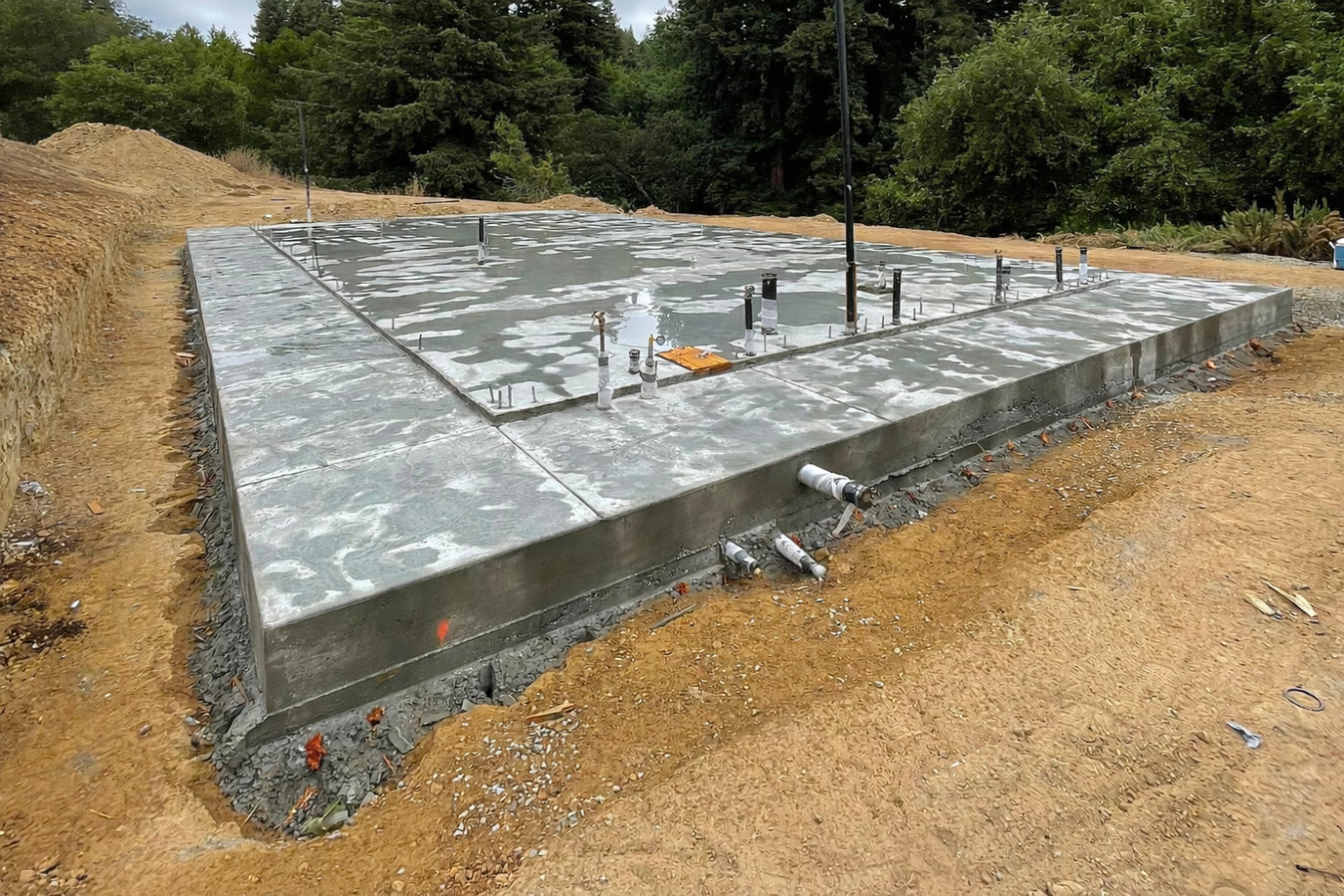
Adding a new structure to your Whittier property? Your foundation has to be right before anything else can happen. We build slab foundations designed for local clay soils, seismic conditions, and city permit requirements.
Slab foundation building in Whittier involves excavating, grading, and compacting the soil, placing steel reinforcement and a moisture barrier, and pouring a concrete slab that serves as both floor and structural base for your new structure - most residential jobs take three to seven days of active work, plus permit processing time before construction begins.
A lot of Whittier homeowners are adding accessory dwelling units, room additions, and detached garages to their properties right now. Every one of those projects starts the same way: the foundation has to be built before any framing, plumbing, or electrical work can begin. Getting this step wrong - wrong soil prep, skipped reinforcement, no permit - means problems that show up years later in cracks, uneven floors, or a failed inspection when you sell.
If your project also needs footings for perimeter walls or posts, our concrete footings service covers that work and is often completed as part of the same foundation project.
If you are adding an ADU, garage, room addition, or any new structure to your Whittier property, you need a new slab foundation before any framing can begin. This is required by the city and cannot be skipped - the foundation is what every permit inspection will check first. Many Whittier homeowners are pursuing ADU projects right now, and this is always step one.
If your existing concrete floor has cracks wider than a pencil tip, or if sections feel noticeably higher or lower than adjacent areas, the slab may have shifted due to soil movement. In Whittier, the expansive clay soils are a frequent cause - the ground swells and shrinks with seasonal moisture changes, and over decades that stress adds up. A contractor can assess whether the damage is cosmetic or structural.
When a slab foundation shifts, the walls and door frames above it shift too. If interior doors that used to swing freely now stick at the top or bottom, or if you notice gaps forming at the corners of window frames, the foundation below may be moving. This is worth paying attention to in Whittier homes built before 1980, when foundation standards were less stringent.
If water sits against the edge of your foundation after a rainstorm and does not drain within a few hours, that moisture is working into the soil directly under your slab. Repeated wetting and drying of Whittier's clay soils can cause the ground to move in ways that stress the concrete above. Addressing drainage early is far less expensive than repairing a damaged slab later.
We handle the full process: site assessment, permit application, excavation, soil compaction, gravel base placement where needed, moisture barrier installation, steel reinforcement, the concrete pour, and final finishing. Every slab we build includes thickened edges along the perimeter to carry the load of walls above - this is not something to skip, and it is something the city inspector checks before the pour is approved. For projects in Whittier where summer heat is a concern, we schedule pours for early morning and use proper curing methods so the slab reaches its full strength regardless of the temperature.
If your project includes foundation installation for a more complex structure - one with raised perimeter walls or a design that requires engineering review - we handle that scope as well and coordinate with any structural engineer your project may require.
Best for homeowners adding an ADU, garage, room addition, or any new structure to an existing property.
Suits Whittier homeowners building a separate living unit in the backyard under the city's ADU permit program.
For properties with an existing slab that has cracked, shifted, or deteriorated beyond repair due to soil movement or age.
Whittier sits on clay-heavy soil throughout much of the city and the surrounding San Gabriel Valley. Clay expands when it absorbs water during the rainy season and shrinks again when summer heat dries it out. That cycle puts steady stress on concrete slabs, and a pour that skips proper compaction, sub-base preparation, or drainage management will show it within a few years. The California Geological Survey maps expansive soil zones across the region, and Whittier sits squarely in that picture. On top of that, proximity to the Whittier Fault means California's building code requires specific seismic reinforcement inside every new foundation - this is checked by a city inspector before the pour.
We work on slab projects throughout the region. Homeowners in West Covina and Pomona face the same clay-soil and seismic conditions, and our crews are familiar with the permit processes and soil conditions in both cities.
We respond within 1 business day and schedule a free on-site visit. Foundation pricing depends heavily on what we see at the property - no honest quote comes over the phone.
We measure the area, check soil conditions, identify utilities, and give you a written quote covering excavation, forming, reinforcement, the pour, permit fees, and cleanup - no partial numbers.
We file the permit application with the City of Whittier Building and Safety Division. Permit approval typically takes one to three weeks. No work begins until the permit is approved.
The crew excavates, compacts, forms, places steel and moisture barrier, and the city inspector approves the setup before the pour. After the pour, most slabs are walkable within 24 to 48 hours.
No obligation. We visit your property, assess conditions, and give you a written estimate. Permits and inspections handled for you.
(562) 358-3090The clay-heavy soils throughout the San Gabriel Valley behave differently than other parts of Southern California. We assess your specific soil before designing anything - so your foundation is engineered for what is actually under your property, not a standard spec from somewhere else.
Whittier sits near the Whittier Fault, which produced the 1987 Whittier Narrows earthquake. Every slab we pour includes the reinforcement California's building code requires for seismically active areas - and every step is inspected and documented by the city.
We file with the City of Whittier Building and Safety Division, schedule the city inspection, and deliver the signed permit record at the end of the project. That paperwork protects your home's value and makes future permits for the same property straightforward. You never need to navigate city hall yourself.
Whittier regularly sees temperatures above 90 degrees from June through September. Concrete poured in extreme heat without precautions can dry too quickly on the surface and end up weaker than it should be. We schedule pours for early morning and use proper curing methods, following Portland Cement Association hot-weather guidelines - so you get the same quality in August as in February.
Every slab project we complete in Whittier is tied to a specific address, a specific permit number, and a specific inspection record. That combination of local expertise and documentation is what gives homeowners something concrete - not just a promise, but a paper trail.
For more complex structures requiring raised perimeter walls, engineered footprint review, or full foundation replacement on an existing home.
Learn moreIsolated footings for posts, columns, or perimeter walls that support a slab or structure above - often completed alongside a slab pour.
Learn morePermits, soil prep, and inspections are all handled for you - get a free on-site estimate before your project timeline fills up.